Blog
A Complete Guide to IP Phone Protocols

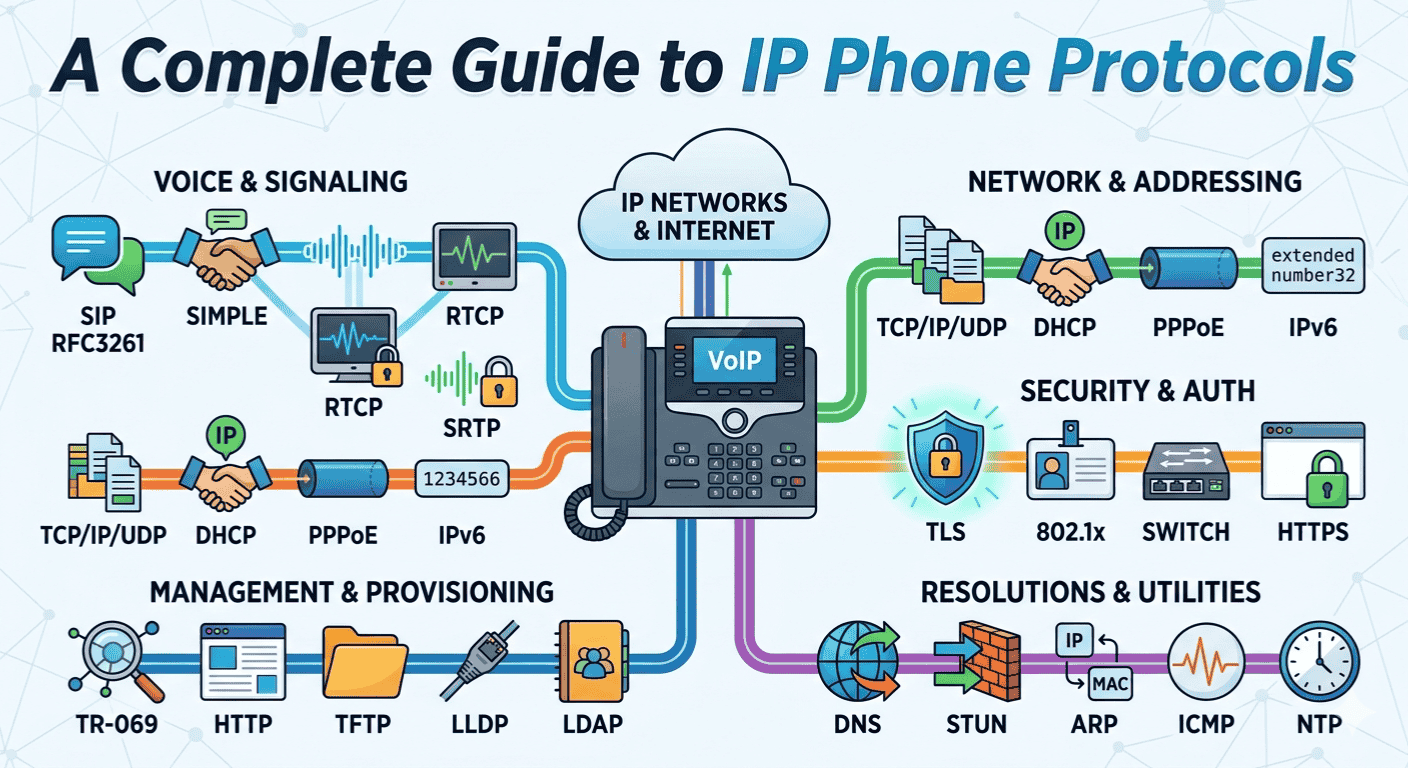
An IP Phone is more than just a device; it’s a sophisticated computer that relies on a specific set of rules to communicate. Below is a detailed breakdown of the protocols and standards that make modern VoIP communication possible.
Core Signaling & Communication
SIP RFC3261: Session Initiation Protocol
-
This is the foundation of VoIP. It handles the registration of the device and manages the setup, routing, and termination of voice and video calls.
SIMPLE: SIP for Instant Messaging and Presence Leveraging Extensions
-
An extension of SIP that manages “presence” information (showing if a user is online, busy, or away) and allows for instant messaging between IP devices.
Media & Voice Quality
RTP/RTCP: Real-time Transport Protocol / Real-time Transport Control Protocol
-
RTP is responsible for delivering the actual audio/video data packets. RTCP works alongside it to provide feedback on the quality of the stream (like jitter and packet loss).
SRTP: Secure Real-time Transport Protocol
-
This is the encrypted version of RTP. It ensures that your voice conversations are scrambled so they cannot be intercepted or recorded by hackers.
Network Connectivity & Addressing
TCP/IP/UDP: Transmission Control Protocol / Internet Protocol / User Datagram Protocol
-
These are the fundamental building blocks of all internet communication. IP handles the address, while TCP and UDP determine how the data is bundled and sent.
DHCP: Dynamic Host Configuration Protocol
-
This protocol automatically assigns an IP address to your phone the moment it is plugged into a network, eliminating the need for manual setup.
PPPoE: Point-to-Point Protocol over Ethernet
-
Often used by ISPs, this allows an IP phone to establish a direct connection to a broadband server using a username and password.
ARP: Address Resolution Protocol
-
This protocol maps a known IP address to a device’s physical hardware address (MAC address) so data reaches the correct physical phone on a local network.
ICMP: Internet Control Message Protocol
-
Primarily used for diagnostics, ICMP sends error messages and operational information, such as when you “Ping” a device to see if it is online.
IPv6: Internet Protocol Version 6
-
The latest version of the Internet Protocol that provides a much larger address space than IPv4, ensuring every IP phone in the world can have a unique address.
Name Resolution & Routing
DNS (A record, SRV, NAPTR): Domain Name System
-
DNS translates human-readable names (like sip.provider.com) into IP addresses. A-records find the IP, SRV records find specific ports, and NAPTR is used for complex call routing.
STUN: Session Traversal Utilities for NAT
-
This protocol helps IP phones discover their public IP address when they are sitting behind a router or firewall, ensuring that incoming calls can find the device.
Security & Authentication
TLS: Transport Layer Security
-
TLS encrypts the “signaling” (the SIP messages). While SRTP protects the voice, TLS protects the identity of the callers and the details of the call setup.
802.1x: Port-based Network Access Control
-
A security standard that requires a device to provide credentials before the network switch allows it to access any data, preventing unauthorized devices from plugging in.
Management & Provisioning
TR-069: Customer-Premise Equipment WAN Management Protocol
-
This allows Service Providers to remotely manage, configure, and update the firmware of thousands of IP phones at once from a central server.
HTTP/HTTPS: Hypertext Transfer Protocol / Secure
-
These are used to access the phone’s web-based settings page and to securely download configuration files and firmware updates.
TFTP: Trivial File Transfer Protocol
-
A simplified file transfer system often used in local networks to send configuration files to phones as they boot up.
LLDP: Link Layer Discovery Protocol
-
This allows the phone to “introduce” itself to the network switch. It is commonly used to automatically move the phone into a specific Voice VLAN for better call quality.
LDAP: Lightweight Directory Access Protocol
-
This protocol connects the phone to a central company directory, allowing users to search for coworkers’ extensions directly from the phone’s screen.
Maintenance & Utilities
NTP: Network Time Protocol
-
NTP synchronizes the phone’s clock with a master server, ensuring that call logs, timestamps, and security certificates are always accurate.
TELNET: Teletype Network
-
An older command-line tool used by administrators to log into a phone remotely for troubleshooting. (Note: This is often disabled now in favor of more secure methods).